Value-First Data
Unified Revenue View Part 4: Scope Decision
Watch Episode →

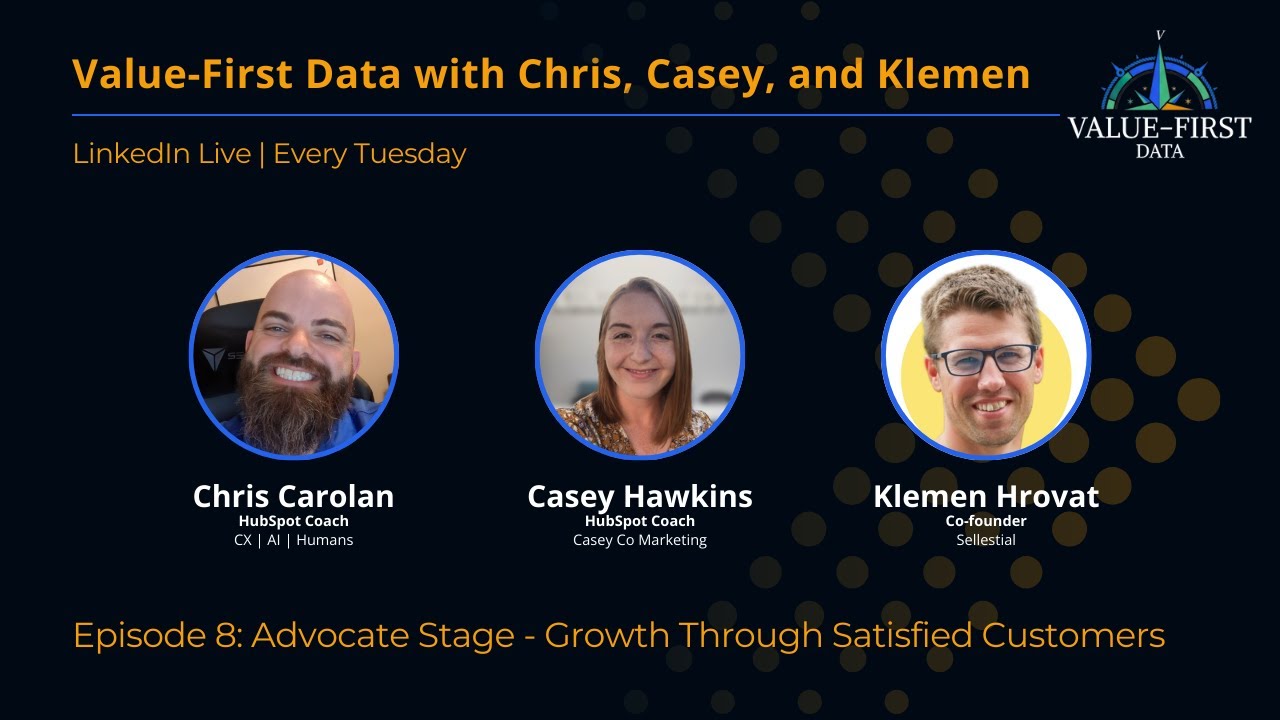
Value-First Data Episode 8 - Advocate Stage: Growth Through Satisfaction
Generated via AI Transcription (Gemini)• 90% confidence
[00:00] **Introduction** Klemen Hrovat: Good afternoon and good evening, LinkedIn friends. Value First Nation, welcome to another episode of Value First data. It is episode eight. Today, we are talking about the advocate stage of the value path. How are we doing Klemen? Good to see you back Casey. Klemen Hrovat: Doing good. Um, excited for this one and the next one to come. Uh, as I told you last week, things are coming together. So, uh, it's good. It's really good. Casey Hawkins: Yeah, the whole crew's back together. Happy to be back. Excited to be here with the HubSpot Community Champion of the Month. Chris Carolan: Thank you guys. I need some advice. How do how does one become a Hubspot Community Champion of the Month? Klemen Hrovat: I don't know. Casey Hawkins: Honestly. Well, Chris, do you the community like in the community thread? Klemen Hrovat: Um, I don't do that much. No. I respond when when I'm tagged. Klemen Hrovat: Uh, I I'm I'm I'm pulled in into some discussions. Unfortunately, I don't have time to really get into that. Klemen Hrovat: Uh. Klemen Hrovat: Were you ever any of you Champion of the Month? Casey Hawkins: No. Chris Carolan: No. Chris Carolan: Oh gosh. Oh gosh. Okay, why then why me? Okay. Chris Carolan: Then why me? Chris Carolan: I I don't think that's hard to answer. Like I think it's clear and I I love the direction that the team is going and it does align with the topic that we're talking about really throughout the series, but definitely today and next week about the champion stage is like um, moving to a place where we enable people to advocate and enable people to be champions instead of trying to pay them to do it, to incentivize them to do it, to do it where we say they have to, right? Chris Carolan: I think that's a transition we're seeing with Hubspot right now where, you know, prior to a few years ago, the community was booming, like it owned, dominated SEO. That's where you went to go get answers and ask questions and share ideas. Chris Carolan: Since then, you know, LinkedIn, Sprocketier, Reddit. Reddit. is a big one now. Like you just can't, you don't get to own the place where everybody talks to each other. Chris Carolan: Yeah. Chris Carolan: Right? So, a lot of what we're going to dig into today, and I remember like going back to the the Data Summit that we had in August. Chris Carolan: It was harder to have these round tables, these last two. I think because the first six stages. And as I share my screen here to, um, going to refresh where we've been, in terms of audience, researcher, handraiser, buyer, value creator, and adopter, um, like there's there's it's more of a process. Chris Carolan: We can set up our system to like kind of track it, measure it, and enable it in a certain way, put our people in a position to make sure that this stuff is happening, that people are moving down this this path. Chris Carolan: But when it gets to advocate and champion, it's very much now like you just got to create the space and like deliver value that you can't force people to advocate or be champions because when you do, it's super obvious, right? That's all we have like sponsored posts and influencers of old and uh, we'll give you a gift card if you make a post. Chris Carolan: Like you just, you can tell when it's not authentic and it never is usually if you're having to be incentivized to do it. So that's definitely a big part of today's conversation. I think Champions are whole whole another level. Chris Carolan: Um but this concept, and a little bit of backstory of when I was putting this together, like because it's easy, again, we talked about it last week, like why are we breaking this up into four stages? Like Advocate sounds a lot like champion. Like Chris, why can't we just call it champion? Chris Carolan: I tried to pick out these moments of differentiation, like when you're seeing teams like experience the value of what they purchased, or what that they put in, right? Any like time, money, effort, investment that's been made. Chris Carolan: Like what you start to see in adopter stage, is them starting to tell each other, right? To get other people on board and what they are advocating in that moment. Chris Carolan: And is it more valuable for you to if adoption is so important, right? Is it more valuable for you to enable them to advocate internally or externally, right? I think externally aligns with this world of like, let's get the leads at all costs, let's get new business. Chris Carolan: Internally, aligns with renew, expand, upsell, cross-sell, resell, all the goals that we have. So that's where this separation came from of, are we putting them in a position to advocate internally? Then when they get really good at that, they will, they will line up to do it externally. Chris Carolan: But when it's external only, that's when it's it's incentives based, like almost always. So that's the backstory of of how this stage came to be separate from champion specifically, honestly. Klemen Hrovat: I would say the the advocate stage, if they're not comfortable advocating for you internally, good luck making them comfortable doing that externally. Klemen Hrovat: Where where the champion and we'll talk more about, no, that next week, but the champion can also be one who just, you know, follows your brand. Klemen Hrovat: I think Casey, you often, you know, talk about Super as as a as a good case that you are there, you know, champion, you talk about Super as as a good case in in in different level levels and but you know, you're not necessarily a user of them. Klemen Hrovat: Where for for the advocate, I think you really need to first be comfortable in doing that internally. Klemen Hrovat: Yeah. And here, you know, data and and then articulation of how value created is adopted and used, can really help you being the advocate. Klemen Hrovat: So you can show the value, ROI, if you will. Uh, and if you can do that successfully internally, then it's, you know, at some point you will realize, okay, why not talk about that externally? Casey Hawkins: Yeah, I think I like that these are broken up because I do think it is it's a different behavior. Casey Hawkins: Um, I'm trying like there are tools that yeah, I like my internal teams using, but I you know, I could say apples to oranges to someone else. Like if they're let's use Asana as an example. Casey Hawkins: Um, I like Asana. If a company has Monday or even is using Hubspot Projects, I'm not so sold on Asana. I'm going to like argue with someone over like what project management tool they should use. Casey Hawkins: Um, so I think that's I think that's the the difference almost in my head. Casey Hawkins: Chris doesn't like that example. Chris Carolan: No, I I think you guys are right. Like it's tangible. Like if it's coming from advocacy, advocacy, right? This is where we talk about the difference between testimonials and case studies and like actual co-creation of of content, right? Like you can get some testimonials from people from people who would who have adopted the product. Chris Carolan: They're like, oh yeah, I know Hubspot, it's working for me, right? Like But we go right to the case study and the the kinds of questions that we need to answer in a case study for a case study to be effective cannot come from somebody who does not use and understand the product and the outcomes of that product, right? Chris Carolan: Like, I think Super is a great example. Hubspot's a great example. Like there are lots of people that like love the vibe of the Hubspot ecosystem. Chris Carolan: But probably can't get close to helping businesses actually use it to feel the value, right? And again, I don't think this is a coincidence when you come back to the life cycle stages of customer or champion. Chris Carolan: Surprise, we have a we have a gap, right? We have an adoption gap. Chris Carolan: We have a gap of people that can actually tell you from their own experience how to get the value, right? We got a bunch of people who can tell you how great inbound is, that they've been to Boston and they've got so many great relationships. Chris Carolan: And we've got a ton of customers way more than ever, meanwhile, we know that we have adap adoption gaps and everybody needs their data clean and all this stuff. Chris Carolan: So, again, that's what brings us back to, you know, the importance of separating these stages out because it's the case study is a great example in terms of if you know the kinds of questions that you want answered in a good case study that supports your go-to-market strategy, then you get good at creating those moments so that they experience the answers to those, to those questions, right? Chris Carolan: Is that a fair way to say it, Klemen? Klemen Hrovat: Yeah. Klemen Hrovat: And if if you understand someone is at at the advocate stage, the depth of their mind and and the answers and and usability of of that, I think will be at a different level. Klemen Hrovat: So it's it's coming from from from them. They're able to articulate and they I think help for every case study, as as I see it, you need to enable them to speak in their own words. Klemen Hrovat: Because that that is how they will articulate the value you bring and it will be if nothing else eye opening for you. So you're not putting words in their mouth, how you want them to to talk about, you know, your product, your service. Klemen Hrovat: And and that can I think only happen, you know, at the advocate stage or or a champion stage where they really feel and are are able to articulate that value where they already experienced that value and they can articulate at at different levels. Klemen Hrovat: And then I think you can you can really get a strong case study uh in their where the answers are in their own words, not you trying to force with you know, short question and answer style to guide them what they need to say. Casey Hawkins: Yeah. Casey Hawkins: Yeah. I mean, it should be straightforward, right? Chris Carolan: Um and so I just need to let the content that's already been done, like do the talking. Chris Carolan: Uh, like so what we're saying, this essential truth here, advocacy can't be bought or requested into existence. It emerges from genuine satisfaction. Chris Carolan: But when it emerges, you can enable it. It's like if you have signals that says, oh man, this person's genuinely satisfied. Here's how I will respond in that moment to get them the video that they need to go share it like on social from a place of authenticity, right? Chris Carolan: So this changes everything when you can approach it from this direction. Chris Carolan: How do we help them share their story? Chris Carolan: Not how do we get more case studies to bring us more leads to help close more deals, which is almost always where case studies are coming from demand generation, right? Is is the reason that we engage in in case study activity most of the time. Chris Carolan: But it's forced, it feels forced every time. Does it I've never seen it sway. The only time I see it sway somebody is if it's the exact same role and title and industry and that person doesn't even read it. Chris Carolan: Like they just see, oh, somebody else like me has gotten value from this thing. Chris Carolan: So okay, that will help like the last 2% of the decision that I've already made. Chris Carolan: Uh-huh. Chris Carolan: Right? And just look at the difference between like these these statements. Chris Carolan: This is why I think the statements are so important, right? You go from I must create value to I realize the value to I tell others to I am I am a raving fan. Chris Carolan: And the differences in the signals, right? Chris Carolan: So advocate, voluntary references, public testimonials, case study participation, right? Chris Carolan: Like if Hubspot approaches me to do a case study, which I I've done one time, I don't know if it's ever been published. Chris Carolan: Uh, but it's like I don't I want I want to do this stuff. Chris Carolan: I want to like co-create some content. I want to go be an inbound like correspondent, right? Chris Carolan: I want to help the whole market learn Hubspot. Chris Carolan: Like I am a raving fan. Chris Carolan: Like I don't like don't ask me for a testimonial. Chris Carolan: That means you don't know me. Chris Carolan: You don't know that I'm a raving fan if you're asking me for simple like testimonials. Casey Hawkins: Yeah. Casey Hawkins: Another thing like traditional like case studies are written like words, right? Casey Hawkins: Um, and I know Chris, you and I were just talking about this earlier today. Casey Hawkins: In 2025, almost 2026, people don't read that many words. Casey Hawkins: So like I also just feel like it's such like a kind of outdated think. Casey Hawkins: When I like seeing quotes from people, um, Chris, there's a quote from you on the event happily website and I saw that recently and I was like, oh shit, and I know you Chris, so I actually was like, oh shit, Chris likes this. Casey Hawkins: Cool. That works. Um, and I know you as a friend, but there's many of people that know you as a like creator too, that would also probably see you. So I can see from all of that to say like I think testimonials like that may still have a place, there's like social proof and everything. Casey Hawkins: But I think these like forcing these like written case studies isn't isn't a great use of anyone. Klemen Hrovat: As as I see case studies for 2026 is this is the input for the remix. Klemen Hrovat: And then making, you know, shorter snippets or, you know, shorter posts or shorter quotes you can you can use. Klemen Hrovat: So if if you have a thorough case study as it was done two years ago, uh, before chat GPT, nothing else. Klemen Hrovat: Then you have the juice, the words you can then use further to, you know, going to to loop marketing to to evolve, to to to get better at at how you you say what you do and and the value you bring. Klemen Hrovat: Um, and to the testimonials, um, point you made Casey, as I see them, it's more of the face of the person, the the the persona of of that person. Klemen Hrovat: As if Chris gave a testimonial somewhere and I trust Chris, I immediately trust that brand. Klemen Hrovat: No matter what he said, I I don't care about that testimonial that's one sentence. If he is willing to put his face there as someone who is giving a testimonial, that is enough for me. Klemen Hrovat: And this is what I would, you know, search in a testimonial. Klemen Hrovat: It doesn't really matter those words. I mean, I I can put there whatever. Klemen Hrovat: But if if you are willing to put your your face there, your title, your human being there, this is the the the purpose of a testimonial. Chris Carolan: Yeah. Then that comes back to trust, right? Chris Carolan: Like so if you didn't know who I was, and then you went and looked me up on LinkedIn and couldn't find anything about who the hell I was, like okay, that testimonial bullshit. Chris Carolan: Yeah. Chris Carolan: Like. And like because I'm in happily slack, I'm happy to to share like the behind the scenes here because it's a part of the game that we're trying to help you break out of here. Chris Carolan: Like it's well known, especially in Hubspot land, the Solutions marketplace and the App marketplace. You need people going to rate, rate your product or rate your company on there. Chris Carolan: It's very competitive. Chris Carolan: And when people are coming in organically, like that's the measuring stick that they're using, right? Chris Carolan: Or that they've traditionally used. Chris Carolan: So it is it's been a strategy, but again, with with with those guys and when Dak asked me, I'm like, sure, I I like, I like you guys, right? Chris Carolan: Um, I was a raving fan, I've always been a raving fan of them. Chris Carolan: That's where them gets separated from like the product or the specific like review that that's being asked for. Chris Carolan: Um But that that game of like he's you likely feels forced to ask me for that testimonial because that's how you used to get found, right? Chris Carolan: As if they showed up ratings and reviews in very specific places, like YouTube, that's a whole like empire on this. Chris Carolan: And what we're seeing now, again, this change in the air of AI, finding true advocacy wherever it exists, and not finding it when it doesn't and when it doesn't, it's not going to try and make it up, right? Chris Carolan: Um, the authenticity of this stuff is just more important than ever. Chris Carolan: So if you look at some of what those signals, you know, might be. Chris Carolan: Um like somebody speaking at an event. Chris Carolan: And again, all of this is value first data is, can you put your customer platform, your CRM, your your data source of truth in a place to receive this data so that we can very clearly see where the human being is in their relationship with you as a company, as a brand, as the human serving them on your team, as different product lines, whichever way you want to slice it, we want to understand that. Chris Carolan: So these are examples like the speaking. Chris Carolan: Like I don't know that I've ever seen this tracked like in a CRM, right? Chris Carolan: And now Hubspot is giving us those signals like as a part of the intent like package, right? Chris Carolan: Mm-hmm. Chris Carolan: Um the way that they talk about you in meetings. Chris Carolan: I'm sure there's a bunch of sentiment analysis that could be done about how much this person loves us in this meeting that we're having. Is this a transactional meeting or are we like talking about like big picture, vision, success? Chris Carolan: Because even in these moments, let's say you're tracking, and in this case, it's like champion behaviors emerging. Chris Carolan: So, the difference between asking for a testimonial here and asking to be on a LinkedIn live to to show in front of the world, like create content in the moment, completely different, right? Chris Carolan: And you can a big part of this value path is, can we put ourselves in a position to respond quickly in the in the most relevant, valuable way so that we can see, okay, this signal is telling me they're ready and we need to leverage that. Chris Carolan: Like if we don't leverage it in this way, it's it's a waste, right? Chris Carolan: They might not ask, they might not ever ask to do it. Chris Carolan: And and this is where it's very hard to get leadership to ask for these kinds of things specifically because it's not measurable, right? Chris Carolan: Yeah. Well but we know like you can you can very easily connect what's happening here to knowing that word of mouth, by far, the best source of pipeline that comes in high fit, high trust and converts faster and everything else, referrals. Chris Carolan: Those things, we know that those are the best sources, but those are sources we cannot control or or measure very well. Chris Carolan: It's it's becoming easier to measure thanks to AI, but you have to create create the space for it. Chris Carolan: So we've got content co-creation, you know, meetings, referrals. Um, specific types of features requested. Chris Carolan: Like, am I asking for a simple fix to this property on this place or am I asking for a new type of Breeze agent? Chris Carolan: That's a different level of ask in terms of like, if I'm asking about Breeze agents, I'm invested in Hubspot and the ability to do really cool things with it that tells you what level of tells you what stage I'm at. Chris Carolan: Am I being introduced? Sorry, go ahead, Casey. Casey Hawkins: No, this is just really interesting. The like the feature request thing, I think is really interesting and a really good way of thinking about like how much someone's really using something because I was sitting here thinking like, how do I, like just about myself, like how do I know where I am in this journey with any company I um I use. Casey Hawkins: I used Asana as an example, um, earlier, but you know, I use software every day, I interact with companies every day. Casey Hawkins: Um, but I think this feature request thing like does show you kind of how how far ahead you're thinking. Casey Hawkins: Um, with your relationship, like you're thinking, I'm planning to stick around with this, so I want, I want this organization to this business to be better because I plan to continue to use the business. Chris Carolan: That's a really good point. Chris Carolan: And an example from 2023 when I was at uh a local event in material science space where I'm from. Chris Carolan: And I was hanging out in somebody's booth at the end of the show and uh somebody who I do content with now, who show on Thursdays called Elements of Interest, the one on like Hubspot AI Space show that I do. Chris Carolan: Um, uh which yes, folks, it's even successful in industrial industrial spaces too. Uh, almost more so, way more space. Chris Carolan: Anyway, um, he comes up to the booth and says he's seen what I've been doing. Uh, uh since many years and invites me to the the budget planning call. Chris Carolan: In in budget planning meeting in January, it was October because that's when the budget gets decided for like marketing. Chris Carolan: Like they wanted to do new marketing things like the difference between inviting me to a budget planning session where the whole leadership team is there versus, oh let's have a call and see like see what you're all about, right? Chris Carolan: So very quickly, he goes from doing research to like oh, huge amount of trust, right? Chris Carolan: This is where we start to have fun with where people are in their journey, like and it's not always linear. If we if I just said, oh, he's researching our hand raising, like that completely misses like what's what's happening here. Chris Carolan: Um, but these introductions are key pieces of information. Like when are they introducing us? Chris Carolan: Um social advocacy, of course. Uh community leadership is is a big one. Chris Carolan: And again, are we tracking anything that's happening like in our community if we don't own it? Right? Chris Carolan: This is where the signals again come up from buyer intent in Hubspot where it's helping bring some of these signals in, which is this community. Chris Carolan: Like you are in the community, you don't own the community. And all the social listening is is is now what you need. Klemen Hrovat: Because there, you know, omni channels platforms where communication about your brand can happen. Klemen Hrovat: I mean Hubspot is in all those platforms mentioned somehow, somewhere. Klemen Hrovat: So they have a lot of places to listen to. And and if you don't, you're missing, you know, this is where where you can implement be where your customers are. Klemen Hrovat: If it is a small subgroup on WhatsApp, I mean fine, this is where they feel called in to talk about that or or you know, complain. Klemen Hrovat: Ideally, you kind of get a sense of of what's happening there. Chris Carolan: Yeah. And when it comes to like what kind of action you can take. Chris Carolan: Like I think that's a great example, Klemen, of like, are you giving them the idea to create a WhatsApp group, right? Chris Carolan: Like there there's a piece of content that you could do that will only work for people at this stage. Chris Carolan: But when it does, it becomes a super concentrated pocket that the likelihood that one of them moves over to champion or that that group moves to LinkedIn or to Slack or like starts to grow. Chris Carolan: Right? Enabling people when they give you signals. Chris Carolan: Like I want to do more. I I like, uh, let's go ahead. Klemen Hrovat: I I like I like Hubspot's approach with, you know, correspondence. You know, they open up apply if you want, you know, if you feel you want to talk more and then you want to talk about it publicly, we'll select a group of of those. Klemen Hrovat: We had, you know, Zoom calls to where Hubspot team was telling us how they can help us. Klemen Hrovat: They were creating, you know, profile pictures as, hey, I'm a correspondent. Klemen Hrovat: They gave, you know, the the logos, asking what else we can help you. Klemen Hrovat: There was a Slack channel. It was all enabling those who who raised their hand that, hey, I'm willing to be an advocate in public for them to make it easier to talk about your brand. Chris Carolan: Yeah. And these two at the end are interesting to revenue transactions as signals. Chris Carolan: Again, and they're both upgrades or expansion of some sort, right? Like a system upgrade package. Chris Carolan: The opportunity to get case studies in this situation, right? And like so often we let the need for the extra deal to get in the way. Chris Carolan: It's like, oh, we don't want to bother them like that right now. Chris Carolan: Like we just need them to say yes and then we get the money and that's what we're measuring success on. Chris Carolan: Whereas if they're upgrading or buying more or like optimizing in this case, like it's because they have a lot of trust and they've received a lot of value and they want more value and you can ask like, oh, what's making you want to upgrade? Chris Carolan: Like you must like appreciate something about our relationship. Chris Carolan: Here are the different ways that you could tell us and and we'll share that because we would love to put it on our website and on our social posts. Or like can we help you tell that that story with others, right? Chris Carolan: Um, these are signals as well. And again, when we come back to the idea of the four unified views, you start to put this stuff together and that's when it becomes the strategic intelligence of business. Chris Carolan: Like how are we doing as a business? Chris Carolan: Like with ourselves, with the market, what are our customers thinking of us? Chris Carolan: Leaders do not stop asking these questions and it's so hard to give them like clearly clear and trusted answers because we're not tracking all of this stuff, right? Together. Chris Carolan: Hubspot makes this pretty easy, guys, too. Chris Carolan: Like I don't know. How do how do we get people to do more of this? To to what extent Hubspot helps with social listening at the LinkedIn posts comments level? Klemen Hrovat: Is there any support already? Klemen Hrovat: Built in? Chris Carolan: You want to take that one, Casey? Casey Hawkins: Um, I think some of this is built in. Casey Hawkins: I I think some of this is still evolving is the political answer maybe. Casey Hawkins: Um, I mean, Chris, you and I have talked a lot about like having AI interpret conversations and things like that and letting AI be the judge. Casey Hawkins: Um, they're you'd you'd still need to build an agent, um, to kind of inform some of that. Casey Hawkins: And not all of the actions you like explained are necessarily like like I can't go and score based on, I can't go into a Hubspot today and score on everything and say this is how likely someone is to be an advocate based on all of the things you just showed. Klemen Hrovat: Uh, but how if at all Hubspot makes it easier to bring the data in the portal in the first place? Klemen Hrovat: So then you can have an agent going through the sentiment of a comment or or a post. Casey Hawkins: Yeah. Casey Hawkins: I mean, what what I would like to see is I would like to see portals where conversation transcripts are sync to Hubspot automatically and then that and this is this is now possible, just like this week, maybe last week, um, that conversation transcript being added triggers a workflow that has an agent run and analyze the transcript and like provide some of this data. Casey Hawkins: Um, whether it's just a field that says like we think this is where the person is, whether it's actually saying like a little bit more of like why if there's specific properties we want, like we want to turn that unstructured transcript data into some structured data. Casey Hawkins: Um, maybe both, probably both. Casey Hawkins: Um But I think that's that's the future of this. Klemen Hrovat: Okay, are we ready for Chris's future? Chris Carolan: I mean, this is so in the social tool, um, we've got comments here. So there's a reply. Chris Carolan: Mm-hmm. Chris Carolan: I actually just turned on listen stuff, so I don't think I'll be able to show it right now. Um, but you know, we see here, assign CRM contact. Chris Carolan: So at the very least, AI will be able to see this on a contact. Chris Carolan: Mm-hmm. Chris Carolan: Um and go also likely. Chris Carolan: And this is where we have much to learn when it comes to the scoring tools still. Chris Carolan: Mm-hmm. Chris Carolan: Like there are social features showing up in the drop downs of what you choose to score in the new uh scoring tools. Chris Carolan: Mm-hmm. Chris Carolan: Right? Chris Carolan: And here we even get boost like positive. Um, and this is I think it's me, it's because I engaged on on your post. Chris Carolan: Klemen, um maybe you're connected to this portal. Casey Hawkins: Yeah, this is. Klemen Hrovat: I am connected, but I think my LinkedIn is connected. Klemen Hrovat: This is probably I guess this is Casey's post. Casey Hawkins: Is it mine? Chris Carolan: Okay. Chris Carolan: Ah, yes. Chris Carolan: Huge. Klemen Hrovat: And I guess Yeah I guess this is Casey's post and now some of the comments on that post. But that is okay, this is what I was yeah asking if you can get that. Klemen Hrovat: And this is the answer. Klemen Hrovat: You can get that. Klemen Hrovat: Yeah. As long as you have the day in that, you know, positive sentiment is obvious and then you can, you know, did someone commented and was the sentiment positive? Klemen Hrovat: This is I know plus something in terms of scoring. Klemen Hrovat: So you go from bringing data in, which is social listening on I was just preparing a post for for tomorrow. Klemen Hrovat: You know, 11 reasons why your employees should post more on LinkedIn. Klemen Hrovat: So if you post more everyone, technical people, sales people, whomever, for all the various reasons on LinkedIn, if you can grab those comments and engagements on the post to Hubspot and of course likes and then just engagements is different but comments, it's unstructured data, then you can have an agent classify that for for the the sentiment. Klemen Hrovat: And if someone is making five comments with a with a positive sentiment on your posts, this is a good addition of scores that should bring you to closer to the advocate stage. Klemen Hrovat: Um yeah, the first step is to get it in but okay, this is possible. Klemen Hrovat: That's good. Yeah. Chris Carolan: And that's through like the social tool, right? We talked about uh the intent tool, um, that I would imagine, again, we have to go back in there and wonder if we got more intent signals to look at. Chris Carolan: Um, but what's going on in spaces that traditionally you you've been unable to track. Chris Carolan: Like if you can think about like that, you have a lot more access now and you just have to ask the question, can I do that now? Chris Carolan: Not, oh, I can't do that. Huge difference, right? Chris Carolan: And that's like first step, but even there with like lower levels of Hubspot, right? Because social you need marketing Pro. Chris Carolan: Mm-hmm. Chris Carolan: Um you have access to the data model where if you just decide that, oh, I want to track engagement in certain ways, Uh-huh. right? Chris Carolan: Literally, I want somebody to get a notification when a meaningful interaction has been observed. Chris Carolan: And that somebody might be a human, it might be AI. Chris Carolan: It might be both figuring out what the hell that interaction meant, right? Chris Carolan: I think we've talked about it a lot. Chris Carolan: The first step is just capturing the data in the first place and starting to understand, was this meaningful? Chris Carolan: Do we even know interactions are happening, right? Chris Carolan: Um and so if we're thinking about signals, right? As soon as it becomes another object, now we can associate it to various things in the portal. Chris Carolan: Um and it relates to properties like the strength of the signal. Chris Carolan: Like what does it relate to you in terms of our business strategy. Chris Carolan: Uh do we know how fast the person is moving based on these two signals together, right? Chris Carolan: Is it telling us they're ready or not? Chris Carolan: You can start to understand on this level and um, like I'm sorry, folks, the hard part is is that you have to do things like this where it's mapping your data model and understanding, oh, we could get
More content you might be interested in.
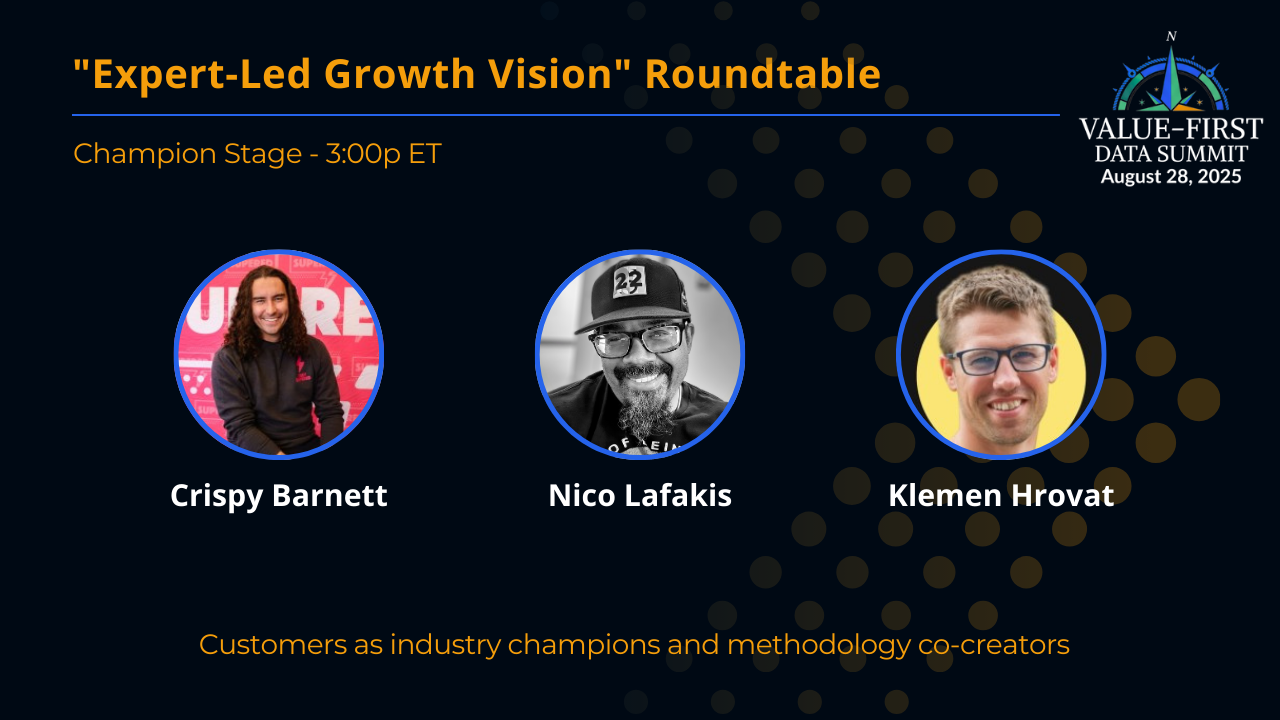
{% video_player "embed_player" overrideable=False, type='hsvideo2', hide_playlist=True, viral_sharing=False, embed_button=False, autoplay=False, hidden_controls=False, loop=False, muted=False, full_width=False, width='1920', height='1080', player_id='195285194558', style='' %} Summit Context: Settin
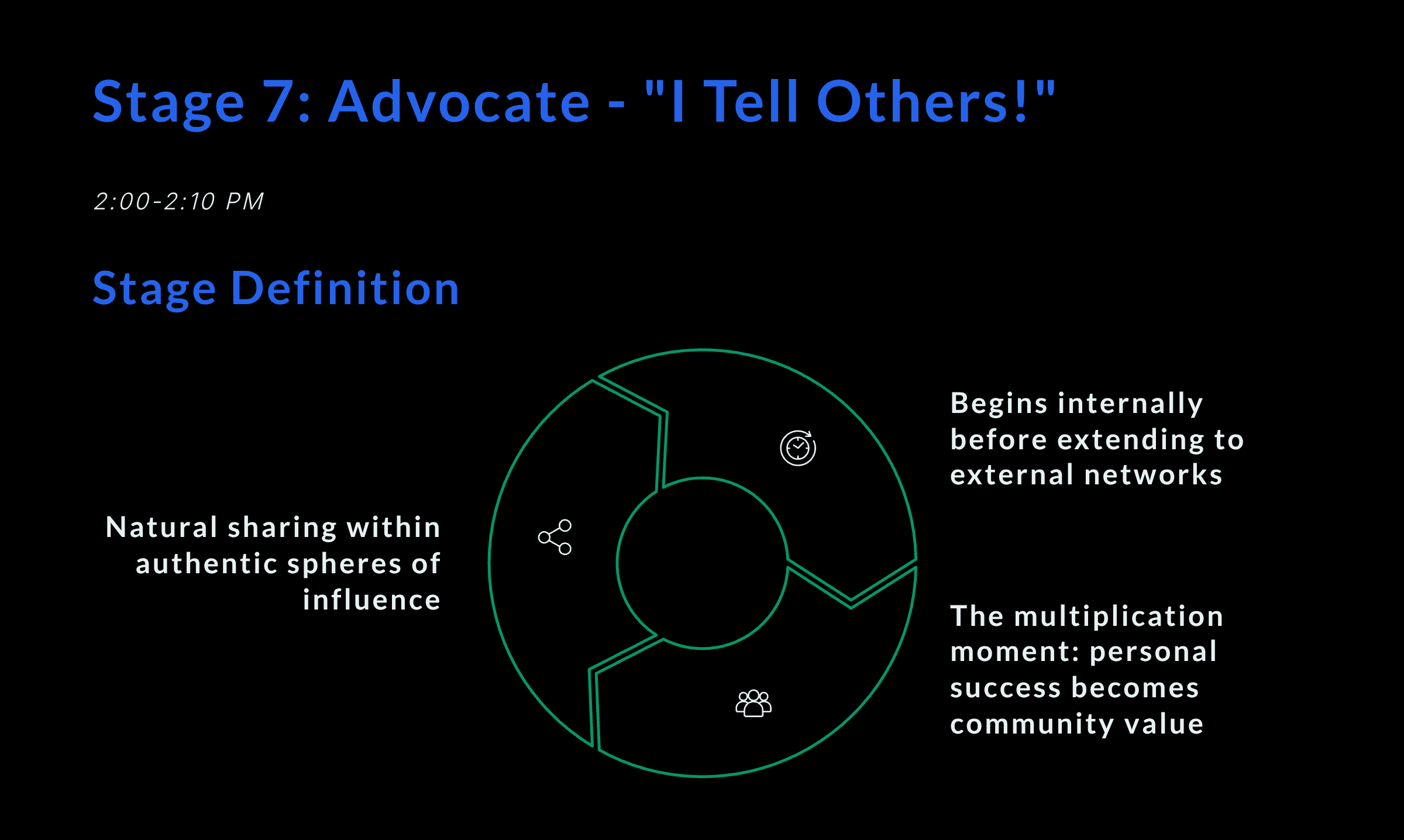
{% video_player "embed_player" overrideable=False, type='hsvideo2', hide_playlist=True, viral_sharing=False, embed_button=False, autoplay=False, hidden_controls=False, loop=False, muted=False, full_width=False, width='1920', height='1080', player_id='196854374831', style='' %} Opening Hook At the Va
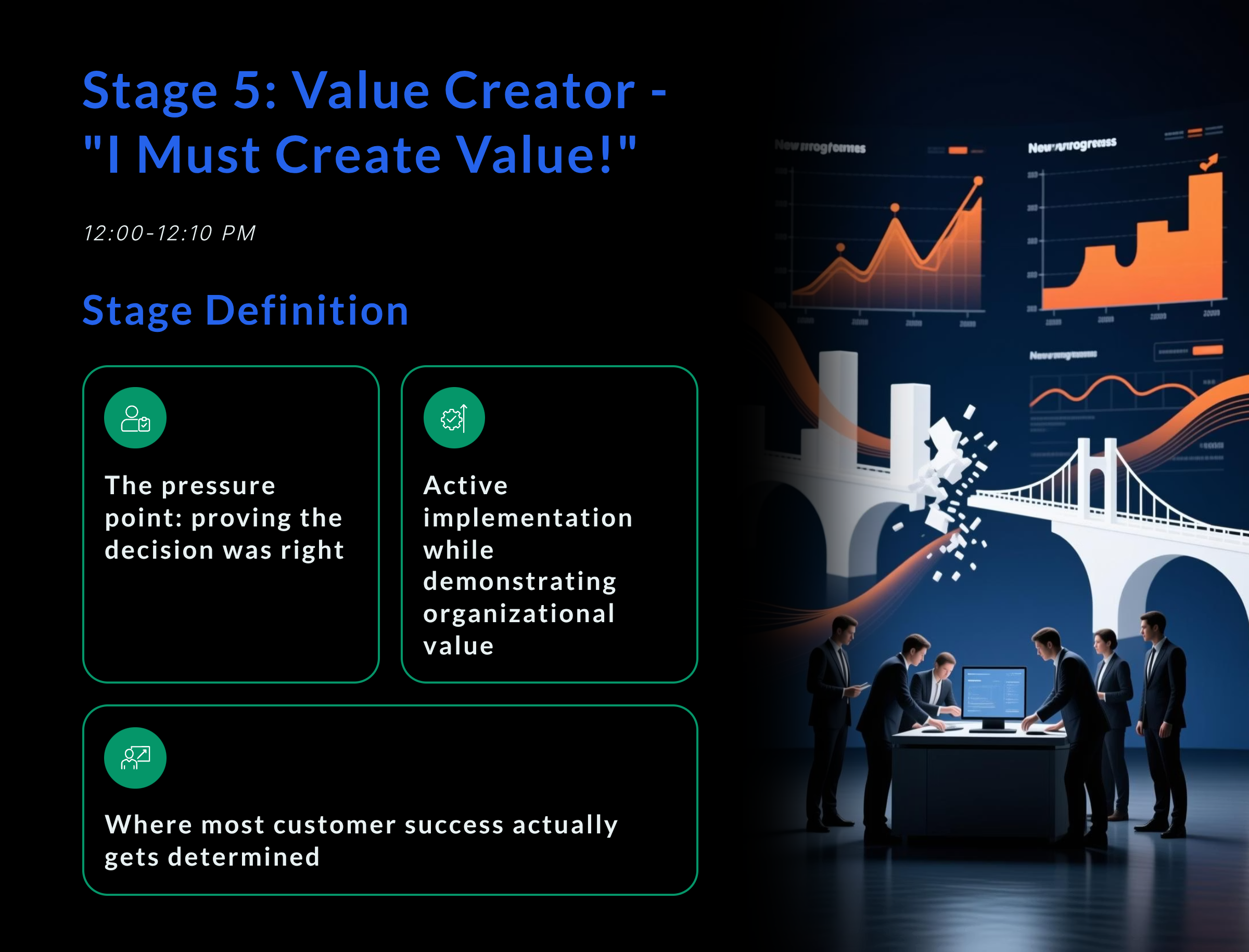
{% video_player "embed_player" overrideable=False, type='hsvideo2', hide_playlist=True, viral_sharing=False, embed_button=False, autoplay=False, hidden_controls=False, loop=False, muted=False, full_width=False, width='1920', height='1080', player_id='196851345200', style='' %} At the Value-First Dat
Subscribe to Value-First Data and never miss an episode.
Courses, playbooks, interactive tools, and data model examples. Everything you need to transform your CRM.
Your donation helps us provide free resources and office hours to the community