Value-First AI Daily
Value-First AI Daily - Apr 2, 2026
Watch Episode →
Value-First AI Daily is your essential source for understanding how artificial intelligence enhances rather than replaces human capability.
Generated via AI Transcription (Gemini)• 90% confidence
[00:00] **Introduction** Chris Carolan: Good morning Value-First Nation LinkedIn friends, welcome to another episode of Value First AI Daily, your collaborative AI Intelligence report here with uh Nico Lafakis. How you doing, man?
[00:17] Nico Lafakis: Doing very well, sir. Doing very well. How about yourself?
[00:21] Chris Carolan: Hanging in there, uh settling in down in uh down in Colombia. Uh, can't complain about the views. That's for sure. And uh, you know, once the internet uh is up to up to par, we'll we'll be good. We'll be good, man.
[00:39] Nico Lafakis: Nice. Um, yeah, I mean like quickly, it'll get there. It'll get there quickly I think. Um,
[00:49] Chris Carolan: Yeah.
[00:50] Nico Lafakis: It's uh, it's a matter, you know, there's going to be more Starlink like companies out there and uh and I'm sure it's going to become more prevalent. And the nice part is, at least like infrastructure wise, it's like whatever gets put in is for the most part very new. So like it's quality wise not too bad. Um.
[01:21] Chris Carolan: Yeah.
[01:22] Nico Lafakis: Uh I almost bought.
[01:23] Chris Carolan: I almost bought a Starlink uh prior to coming down.
[01:28] Nico Lafakis: Yep.
[01:28] Chris Carolan: And now that I'm down here, I uh it doesn't look like I can very easily. Um, so very interesting how this stuff uh is going to like disseminate throughout the throughout the world. Um, but also thankful that like if you look around the area that I'm in, it wouldn't have been surprising if I had not been able to get better internet up, but uh we uh people went to the store yesterday and and upgraded, so that should be happening soon. Um, Nice. But yeah, it's uh always a good, good reminder of how, how good we have it uh sometimes in the United States. That's for sure.
[02:07] Chris Carolan: Especially in metropolitan areas.
[02:11] Nico Lafakis: Yeah, I mean, that that's yeah, that's that goes without saying for the most part, especially when it comes to like medical technology, like advancement in um, you know, what we're doing with. I mean, I would say chip technology, but that's really like TSMC. Um, but we're getting there with, you know, obviously Nvidia leading the GPU uh race in that in that regard. But yeah, it's interesting to watch other countries around the world like make this adaptation, right? Like, are you? I know that you probably haven't had a lot of conversations with people yet, but have you had any conversations where people mentioned AI at all?
[03:07] Chris Carolan: Um, actually yes. Uh, because I've prompted it, but um, you know, definitely I'm very interested in uh, so our niece, um, I think just finished school last year, just finished high school last year. So I was asking her about like how she thought about AI and her main concern was how, how, how it can help people be lazy. Um, uh, which is fair. Uh, uh, but then I also, um, Isabael did a, did a 10k with some friends.
[03:53] Chris Carolan: And he is actually down here starting uh, starting a business. He did solar in the US and now he's down here um, selling solar to to companies that have like sometimes like 200 like power shut offs like per month. Wow. Right? So I was talking to him and the conversation with him was, first he told me that he was using AI to like understand where these solar opportunities were because it can uh, you know, review all the data and like, I'm sure a lot of environmental data and things like that. Yep. But also, I started talking to him about the success I've been having building websites and digital experiences and it's very easy and he was, he's interested in in following up because he thought, I asked him if he had a website yet and he said no, because it's not a priority right now and it costs a lot of money and it takes a long time and I was like, all right, well you're gonna enjoy what I'm about to show you because that's when you get the beautiful thing right now is these super smart people that just think this wall is still there, right? And, and those are the ones that can have the biggest impact when it comes to creating these digital experiences because you just need to tell Claude Code, you know, what you want. And if you have the insights to like the, the market insights, just all the contextual insight, right? That you can add in, um, and turn that into like just valuable experiences very quickly. Like how many more businesses can you help because he doesn't have to go through all the slide decks and he's got a website that can be shareable. And if these are businesses that are really suffering from these power issues, 200 times like he can have that much more impact, that much faster. And of course, I wouldn't really know anything about solar had I not been listening to moonshots consistently. So that, that connection was like, okay, all right, it's all coming together. But um, I wanted to mention the other thing we just heard on Moonshots, uh, or I just heard on Moonshots was um, the easing of GDPR restrictions in in Euroland.
[06:41] Chris Carolan: Um.
[06:42] Chris Carolan: And that, how about, how about that for an example of AI pushing like in a direction that nobody would have like I don't think anybody would have expected that uh, at least, you know, without like connecting the dots a lot. Uh, but that for pushing experiences, you know, in a direction, I'm not going to say right or wrong. Right. But just having an impact that you wouldn't expect necessarily um, because businesses over there, they're so far behind because they don't have access to the same amount of data as, as the US.
[07:34] Nico Lafakis: Yeah, I mean, you know, certainly, well, so and it is on a, on an international scale, for sure, right? Very few international businesses break into the US market and that's like that's a thing, right? Like breaking into the US market. So um, yeah, I would, I would wholeheartedly agree and the fact that, I mean GDPR has been such a strong strong gate for Europe for so many years. So it's it is, it's quite shocking, but at the same time, this comes on the cusp of the US government having released pretty much all of their public data for training on AI models as well. So like we're, we're having these like data dump parties now where it's like who can dump the most data publicly? Um, and I, I think it's, you know, we're just, we're taking huge, huge leaps forward, really. Uh, I know that Google is probably first hands on the data since they have contracts and everything. So that, I hope leaks over into Deep Mind and like somehow gets us, you know, another whatever, 25 or 50 years ahead, not that we necessarily need it at this point, right? Like it, I don't, I don't think people realize that if if we were to stop AI today, right? Just like turn it off, you know, shut down the power, you know, power to it, stop building data centers, all that stuff. Outside of the tremendous amount of job loss that would happen, um, the amount of research that we would still have would still take us decades to go through.
[10:00] Nico Lafakis: So that, like that's how much information we've collected so far. It's so, it's so much that if we didn't have AI, we couldn't even process it, handle it, understand it, to break it down because we wouldn't have the time to be able to do it. So yeah, I mean, going from, you know, where we were and I'm looking at, you know, we I was talking about it yesterday in terms of timeline. You know, we went from nothing in my opinion, especially if you look back at it now, it's definitely you can, you absolutely can see what Sam was talking about. Um, to exactly what you were, I don't know if you saw what Ryan Ginsberg posted yesterday. It was a great uh tweet where a programmer was talking about how a friend of theirs essentially replied to them about what their daily job is like now as a programmer and they were like, well, I essentially just tell either cursor or Claude code what it is that I need and then I just review it. And that's my job now, right? And the remark was, we've crossed some invisible barrier that and like silently in the night without having even said anything, right? And it's very true. Those who have, who have adapted and adopted because another wave that I'm also listening to this week is exactly, God I love, I so love it when we're right. I really do. Um, we've been talking about for months that like if you are creative, that this is your springboard. This is how you like move forward into the future faster without any gates in front of you whatsoever. Especially when it comes to programming and even though it you think, again, like you would think that there's I, I thought myself, right? Like I was one of those people initially. I'm like, man, okay, uh you know, programming. Yeah, it's it's baller and you're like, yeah, you can build this stuff. It's awesome. But man, not everybody's going to want to do this, right? Like not everybody's going to want to like code some stuff. Like, yeah, I don't know. Like especially people who have nothing, who are not like anywhere near like what we do have nothing to do with it. I'm like, I don't know. And then seeing my wife get into it and to the point where she, she shows me yesterday, she's like, yeah, I'm working on my second one. I'm like, wow, you are days into it and you are already working on your second app. Like, yeah, okay, I think if more people get exposed to this, we're going to see that like that economic explosion because business after business, I just watched another talk this morning from Forbes from Forbes Under 30, watched a talk from a guy who was talking about how he started his business from no investment money whatsoever and is now pulling something like 230k uh MRR. Right? So I don't know, I don't know.
[14:18] Chris Carolan: Well, that's the thing. We, we've talked about and that's what I try to tell people whenever the conversation about uh, like just apps and how especially in our space, how consultants and service organizations can make money and what they can make money on, right? Like if you're banking on this gap, this knowledge gap and capability gap and people don't know how to do things. So I'm going to do things for them because and they're going to pay me. It just takes like it's available to you right now, but you have no idea when it's going to stop because it's wholly dependent on that person or that organization waking up to the moment where they're like, oh, oh we can do this. Oh, we're good. Thanks. Like 30 day notice later. Like because that's where we're at. I mean you have lay people making apps. Come on folks, like and they're good apps too. It's not just like. You're not BS. It's like. We're yesterday. I'm just. You know. Not even. To me it's off the cuff stuff at this point. Like once you really start getting into it, your off the cuff apps are going to be amazing. So it's, it's like you're able to solve your own personal problems in like a couple minutes that will save you time forever. Case in point, I have a, you know, we've got a GTM uh operating system we put together. The engine takes specific properties. Okay, rather than me having to continually create recreate these properties all the time in every portal that I'm going to install this engine in. Nope, hey Claude, create me an an app that creates these properties, puts them in this property group. Here's the property types that they are and all I need to do is put in my private app token and hit a button. Okay, do do do do do. Two, three minutes later, hey, I'm done, here you go. Nice web app, you know, web UI and everything like that. Private app token reads it, pulls up the schema for all the properties it's going to create, hit the button, do do doot, properties done. That's it. Forever now, my, my whole thing when I have to create properties in a new in a new instance is just private app token, boom, done. I never, ever have to manually do that shit, like create a manual property ever again, right? I don't even care that there's the AI property creator. I've got to be honest with you, that thing is super annoying. Like it is, it straight up, it is faster for me to create the property than it is to use your AI mode. And it's actually you've slowed me down because I now have to look for this. I have to like physically memorize where that little like link to go through past the AI mode is. Um, but yeah, that's, that's, and, and it's like and that's going to be for everything, right? And it it only metastasizes. So as soon as like more reporting capabilities are out, all of my reports are going to be push button. As soon as more workflow capabilities are out, all my workflows are push button. So even if, this is where we were talking about, like Text Stack Reimagined, even if HubSpot doesn't make these things possible, I will have my own like hub app specific to our business that specifically injects our stuff and builds out our stuff to the point where like, yeah, I shouldn't have to. I shouldn't have to go into HubSpot and spend hours. Like that's not client value. That's not valuable to anyone. It's, it's just a waste of time, right? All of this stuff, I really, like, I'm not trying to be an asshole at all, but like all of this stuff about like, well, you don't know how to do the technicals of it and if you don't know how to do the technicals, why do you need to know how to do the technicals to get the result? You don't. Right? Not anymore like. Right. Like if I need a workflow to do this, I don't necessarily need to understand how the workflow works. I just need it to do this thing so that I can move on to the other thing that's way more important than knowing how to do the workflow, right? Yeah. So you know, it's definitely, it's amazing to me.
[19:35] Chris Carolan: Yeah. And I might have mentioned yesterday in passing, but like like George showed me Sanity.io on Friday. I worked with Claude and this is having like the whole stack was uh, you know, HubSpot, um, GitHub, Versel, Claude Code, Claude. Basically, and um, I was running into that moment where I was recreating like a CMS basically like on my own and that's when George brought up this idea. He had found Sanity to do this as a content operating system. And I was like, yeah, that makes sense. Uh, so I have the conversation with George. I'd already started prepping Claude code. So he looked into what Sanity was, right? And how to use it and how, how it worked and how APIs worked and all that stuff. I come back with all the teachings from George. And I'm like, all right, make the plan, right? And there's a big long like plan of switching from static and hard-coded content to Sanity based content. All I had to do was like create an account, create a key and a create a project and then create a key and then give Claude that key and almost I have not touched Sanity after that. When I've gone to look at it a couple times, like so much is, it's like a full-fledged software platform that has all been built by, by Claude to support the website and the, and the process, right? And I actually look forward to going to like like manage content in there. I just haven't had to. It's like and that's oh man, that's where we're at. Like what you described, um, you know, I, I'm putting that capability all over my website because I do a lot of, there's a lot of education on the Value-First team website. Um, there's a data model designer, uh, there is a My Value Path portal, which is like connected to all the HubSpot objects and I had a client asked me like, oh, could I put some of this in our portal because there's like a project management access aspect to it? Yep. Uh, and I was like, you know what? Yeah, we probably could do that so that I help build out the whole project management infrastructure of the project that we're doing together and then you can just put your key in and now it's in your HubSpot, right? Like and um, and where, where, where I am with the data model designer was literally like, okay, got the data model up. It would be cool if I could just push these into HubSpot. Oh, I can push them into HubSpot. It would be cool if I could pull them in to the data model designer. Okay. And you can do it. Okay. Okay, Claude. Go ahead and look at the rest of the API. What else can we do? Right? Oh, we could bring in workflows to this layer and we could probably bring in forms because I'm doing it like, like I'm always envisioning Canva. And this is where like we have these all these separate tools that we've had to use and I was talking to some HubSpot PMs about this yesterday, at some point you're forced out of HubSpot to actually plan and design because none of that stuff comes together. Um, and if we can make and if there's a space where you can do it together, that's what people admire in Canva and Lucid 4, right? Um, but being able just being able to say like, look at the rest of the API. Like, what could we pull in, right? That's what it just takes that one mindset shift of moving from I need to do this to what else can we do, right?
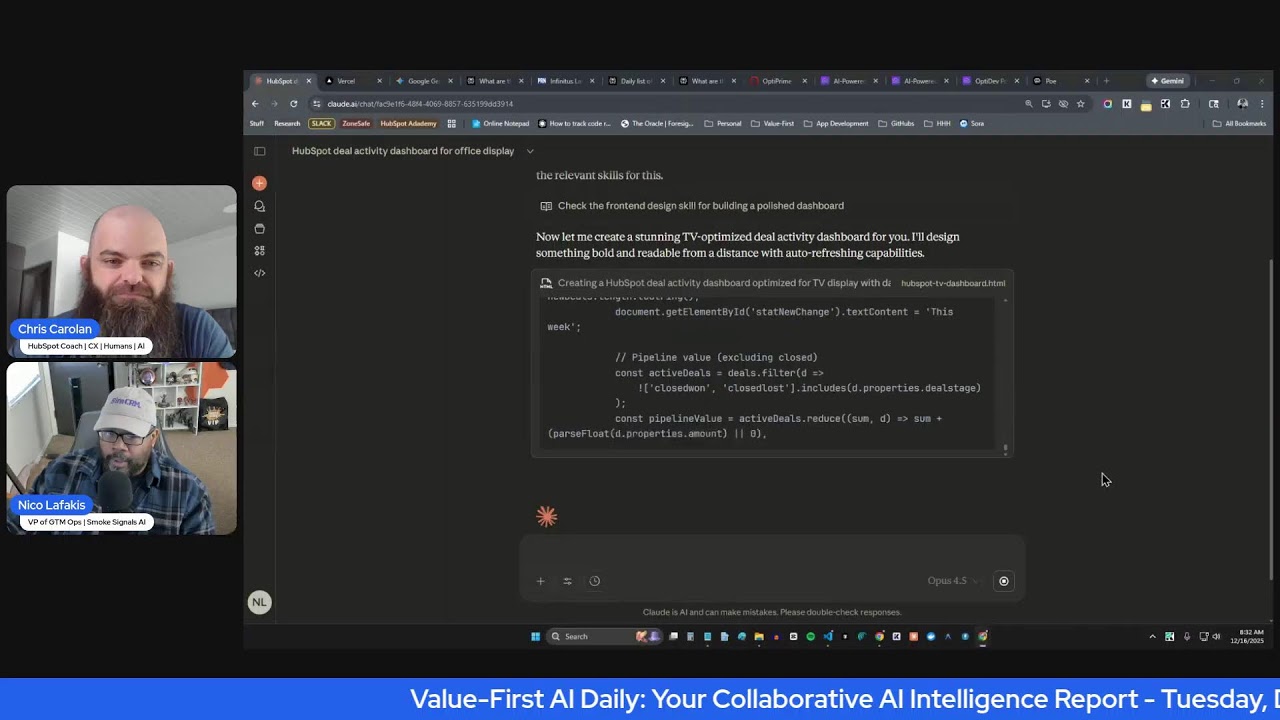
[24:54] Nico Lafakis: Mm hmm. It's, it's a whole new, I think that like the stories that I'm reading this week, um, are not foreign to me. Um, and we kind of, I mean we again, we've been talking about this, like we've been talking about how important it's going to be um, in order to learn these skills, right? And so what I'm coming across week to week now are stories where there is a marriage between marketing and Claude Code, marketing and Vibe Coding, marketing and app building. And story after story is going into, hey, this is what you guys should probably be thinking about now. You should be thinking about app creation. You should be thinking about closing the gap on integrations. You should be thinking about how you can take what you already have as far as data and push it to the next level. And what I'm seeing pop up more and more are these new uh prompt to app tools that are super easy to use. Like even more inviting, let's say than like, cause you know, when it comes to us, you know, talking about Cloud Code and even when it comes to like GPT or Gemini, it is a little bit like cold of an interface. I think Google does a better job when it comes to the AI studio. Um, but there's going to be more and more of these services that are coming out and they're building, what's crazy to me is that when it all first started, there was all the hullabaloo from the programming world about like, yeah, but you're going to need us to come back and clean it up for you because it's going to be, you know, straight garbage. I've looked at stuff like again, across the the time that this stuff has been out, especially from Replit and more importantly from um, oh boy, and then the, the, it just flew right out of my head. Um, there was a app marketplace for agents uh that had been out like fairly early on and is still out and doing extremely well. And when I saw that, I was like, wow, this is pretty interesting because people are spending a lot of time making agents when they could just come to this site and and buy them or at least hire them. I want to say it was called Poe or something like that. Um, and yep, Poe. And so this uh this site was like, it is. It's like a marketplace for building stuff. It's a marketplace for using stuff. If you want to use certain models, if you want to build on certain models, um, everything like what's crazy is how much stuff is here that people don't know about. Like there is a whole world of bots and agents here that people have no clue that they even exist, right? Um, honestly, like some of these things are, are blowing like my mind when I look through the uh repo yesterday. And so what's crazy is that like people were just like, yeah, but you know, what are we going to have? We're going to have like all these apps or whatever? And it's like, yes, instead of apps, you're going to have agents. So you're looking at an agent marketplace, right? Like this isn't an app marketplace anymore. It's an agent marketplace. And to me, like, all the better, right? And this, you can see it's like more playtime stuff, but a new platform, OptiDev, and it's, it's pushing itself in marketing and it's pushing itself to the business and enterprise level. So it's not like Replit where it's trying to be at, you know, first stage uh user level. It's trying to be something more for um enterprise level. And you can see it's got that nice Miro like feel to the background. Um, what I thought was the most interesting was their prompt library. I was like, wow, this, this actually, this is what reminded me of Poe and I was just like, okay, so you have like full apps like built out, right? Like it's not, you know, this is the kind of stuff that me and Chris and and George mess around with, right? Right. And so what I thought was really great about this was this part right here. Only because I just if you guys see like how not complex this prompt is and where the person put the end points in, that's great. But you could real, you could legitimately just say, search the HubSpot developer documentation for the proper end points for this. Yeah. Or proper API use or whatever it is, right? But you can see that it's like it's nothing to build out like these full application Stripe dashboard, Zendesk dashboard, build your own directory. that. Go back to the HubSpot one real quick. Sure. Like the top line of the prompt in the black, right? I'm a sales manager. I need a dashboard to display on our office TV showing recent deal activity from HubSpot CRM. That's it. That you all that's all you would really need to do. Yeah. And then all the questions that it's going to ask is going to relate to your specific HubSpot and your business, right? Like oh man. Um and right. This is what I want. Like when I say what the hell are we doing making slides anymore? It's going to take business leaders saying, all right, no more slide decks. Here is this vibe coding experience. Here's your 15 fucking minute training on it. Everything you do from now on that would have been slides, you do in here and you create and we create this foundation that helps everybody and there's no more there's no more one and done like work being done. Like imagine that. Oh my lord, all the waste that goes into Excel files and PowerPoint files and docs that just get stored. Sometimes you don't even get to present that shit, man. No. And then it just sits there. It's like just 100% waste, right? Um, and AI like when you do it in these spaces, AI won't even allow you to make, to let it be wasteful to be like, hey, you did this before. Like can we just reuse that? Right. Like. Uh, and yeah, but it's going to take leaders and it's, I'm glad you're showing this OptiDev because I've been thinking about this a lot. It's like leaders have to find a way to be like these, these traditional ways no longer acceptable. Like you will get demerits if you used PowerPoint moving forward basically. Right. Right. Um, Yeah, I mean, I, I know it's it's something that like I know that that we can run on forever, but I know I know we're a little over time. Um, but this is honestly, like what you're, what you're looking at, what we we're talking about. Yeah. You know. Get into it.
[31:31] Chris Carolan: Yep. And we'll show the outcome there tomorrow. Um, uh, and probably some other stuff too. Hopefully I have good internet and we can share it easily. Uh, but until then, everybody have a great Tuesday. No problem. Thanks so much, Nico. No problem. See you guys.
More content you might be interested in.
Subscribe to Value-First AI Daily and never miss an episode.
Courses, playbooks, interactive tools, and data model examples. Everything you need to transform your CRM.
Your donation helps us provide free resources and office hours to the community